Multimedia Comic

Germs vs You Comic: How illness happens and how we can prevent it.
Updated: February 24th, 2026
Updated: March 4th, 2026
Author: Jenna Falkenberg
Introduction
I chose this topic because illness is something everyone experiences, yet many people especially the younger age groups misunderstand how infection works. My goal is to help young learners understand the biological process of infection to help them connect and understand why preventative behaviours are effective. The comic format allows visualization of an invisible processes that happens inside the body while maintaining accessibility for broad audiences.
FINAL DESGIN COMING SOON
The Process
Understand (Discover, Interpret, Specify)
The Challenge:
Younger age groups experience illness regularly but often misunderstand how infection occurs. The challenge is that germs are “invisible” so kids struggle to understand how illness spreads and why behaviours like handwashing prevent it.
Context and Audience:
This comic was designed for elementary school students specifically grades 2-4 who are beginning to learn more about personal health, hygiene, and the human body. According to the British Columbia Science Curriculum, the study of human body systems is introduced in Grade 5 Life Sciences, where students examine the major body systems and how they interact to support survival. This comic is intentionally designed as a foundational resource that prepares students for that later learning. Rather than providing anatomical details, it introduces key concepts such as germs, infection, immune system, and prevention in an accessible way. By building early conceptual understanding, the comic supports preparedness for more complex exploration of body systems in Grade 5 and beyond. Children in this age range frequently experience illness but often lack a clear understanding of how and why it occurs. While most students are told rules such as “wash your hands” or “cover your cough,” they may not grasp the biological reasoning behind these behaviours. Because germs are invisible, hygiene practices can feel arbitrary rather than necessary.
The typical learner at this stage has basic reading skills but demonstrates varying levels of comprehension and attention benefiting from visuals and structured explanations. They are most engaged when learning feels relevant to their own experiences and when the content feels achievable. Extreme cases include students who face additional learning or accessibility challenges. Students with dyslexia or other reading difficulties rely heavily on visual supports and simplified text. Students with ADHD or attention differences benefit from information that is broken into small, manageable segments. By accounting for these diverse needs, the comic is designed to be accessible, engaging, and meaningful for a wide range of learners.
To support comprehension, extraneous cognitive load is reduced through simple panel layouts, minimal decorative elements, and consistent, concise text. Intrinsic cognitive load is managed by breaking the infection process into clearly defined stages such as exposure, entry, replication, immune response, symptoms, and prevention. Allowing students to build understanding step by step. The comic promotes active learning through embedded question prompts and a “Test Your Knowledge” interactive game at the end. These elements encourage students to reflect, predict, and apply what they have learned rather than passively consume information. The opening panel activates prior knowledge by inviting students to recall a time they were sick, helping them connect new scientific concepts to familiar personal experiences. This supports meaningful learning by linking new information to existing schemas.
The resource also incorporates principles of accessibility and Universal Design for Learning (UDL). Information is presented through both visual and text formats, key ideas are broken into manageable segments, and interactive components provide multiple ways for students to engage with and demonstrate understanding. These design choices ensure that learners with diverse abilities, backgrounds, and learning preferences can meaningfully participate in the learning experience.
POV Statement:
A grade 2-4 student who has experienced illness but lack biological understanding and needs a clear visual explanation of how infection occurs so that they can make informed prevention decisions and reduce misconceptions about getting sick.
Learning Objectives:
By the end of this comic learners will be able to:
- Define germs as tiny living things that can sometimes make us sick.
- Describe how germs enter the body (through the nose, mouth, eyes)
- Explain how the body fights germs (the immune system.)
Through the interactive activities, students will also be able to:
- Identify ways to stop the spread of germs, such as washing hands, covering coughs, and not touching your face.
- Understand the process of infection from exposure to feeling sick.
Plan (Ideate, Sketch, Elaborate)
Ideation:
As a science major, I began my brainstorming process by examining the British Columbia Science Curriculum to understand when students are formally introduced to biological processes of the human body. Through this exploration, I found that the study of body systems is not introduced until Grade 5 Life Sciences. This observation led me to consider a gap in earlier grades. Young learners in Grades 2–4 experience illness frequently, yet they are not formally taught how infection occurs or how their bodies respond. While they are often told to wash their hands or cover their cough, they may lack a conceptual understanding of why these behaviours matter. They are also at an age where they want to understand the why of things. Because germs are invisible to the naked eye, the spread of infection can be confusing, and prevention behaviours may seem arbitrary. This realization shaped my design prototype objective: How can I make the invisible process of infection visible and understandable for younger learners before formal instruction on body systems begins?
Storyboard or Script:
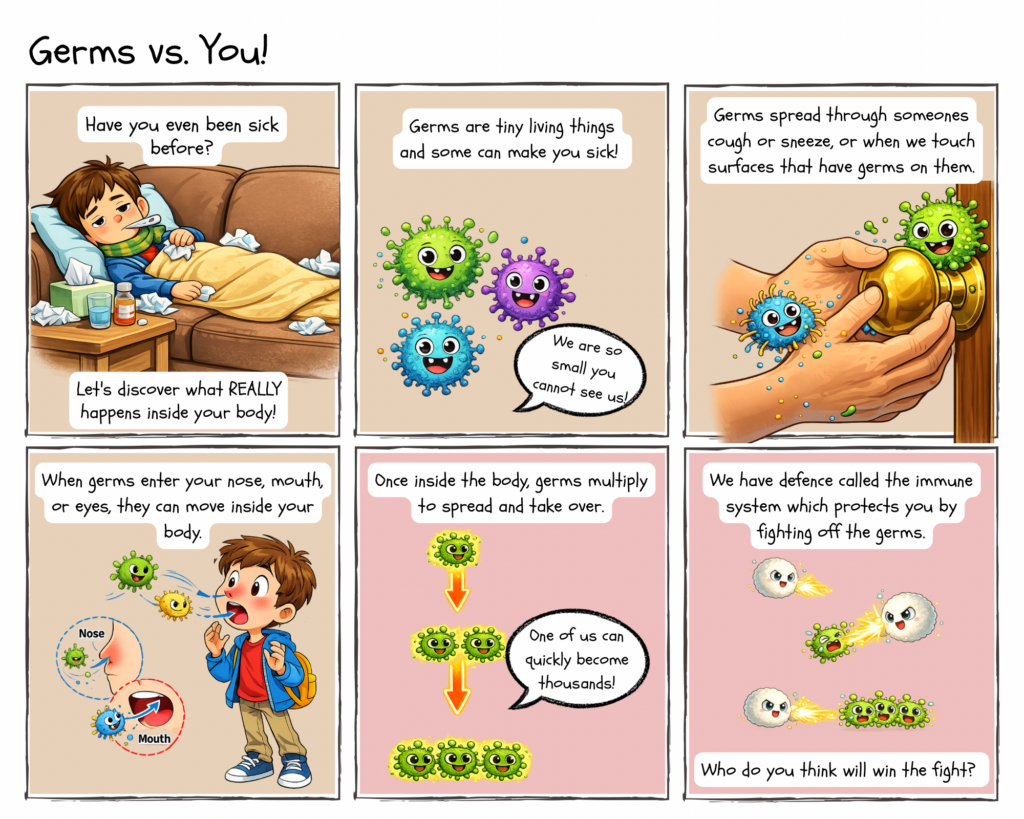
1. Have You Ever Been Sick Before?
This panel activates prior knowledge. It encourages students to think about a time they were sick, helping them connect the lesson to their own experiences. This increases engagement and prepares them to learn new information.
2. What Are Germs?
This panel introduces the main idea before explaining the process. It defines germs in simple language and makes them visible through illustrations. This helps reduce confusion later on. “Germs are tiny living organisms that are so small you cannot see them, and some of them can make you sick.”
3. Exposure
This panel shows how germs get onto our hands (for example, by touching surfaces). It begins the cause and effect sequence of infection.
4. Germs Enter the Body
This panel explains how germs enter the body when we touch our face. It builds on the previous panel and continues the step by step process. This supports operational thinking which is typical in grades 2-4.
5. Germs Multiply and Spread
This panel shows germs multiplying inside the body. It helps students understand why such tiny things can make you sick.
6. Immune System Defending
This panel introduces the immune system. It explains that our bodies can fight germs. Avoiding over complex anatomical detail just stating that the body does have the ability to defend itself.
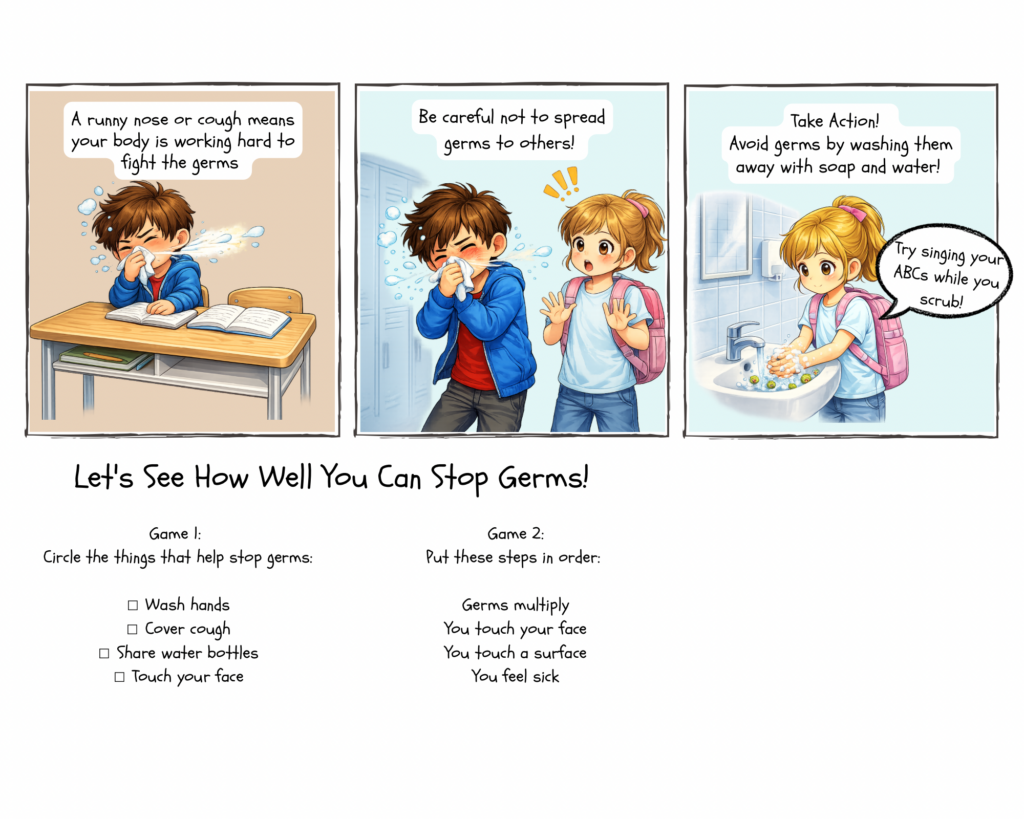
7. Symptoms Appear
This panel connects the internal fight (immune system vs. germs) to things students can see and feel, like a runny nose or cough. Which helps students understand that symptoms are part of the body’s defense system.
8. Be Careful Not to Spread Germs
This panel explains that germs can spread to others. It builds social awareness and reinforces how infection moves from person to person.
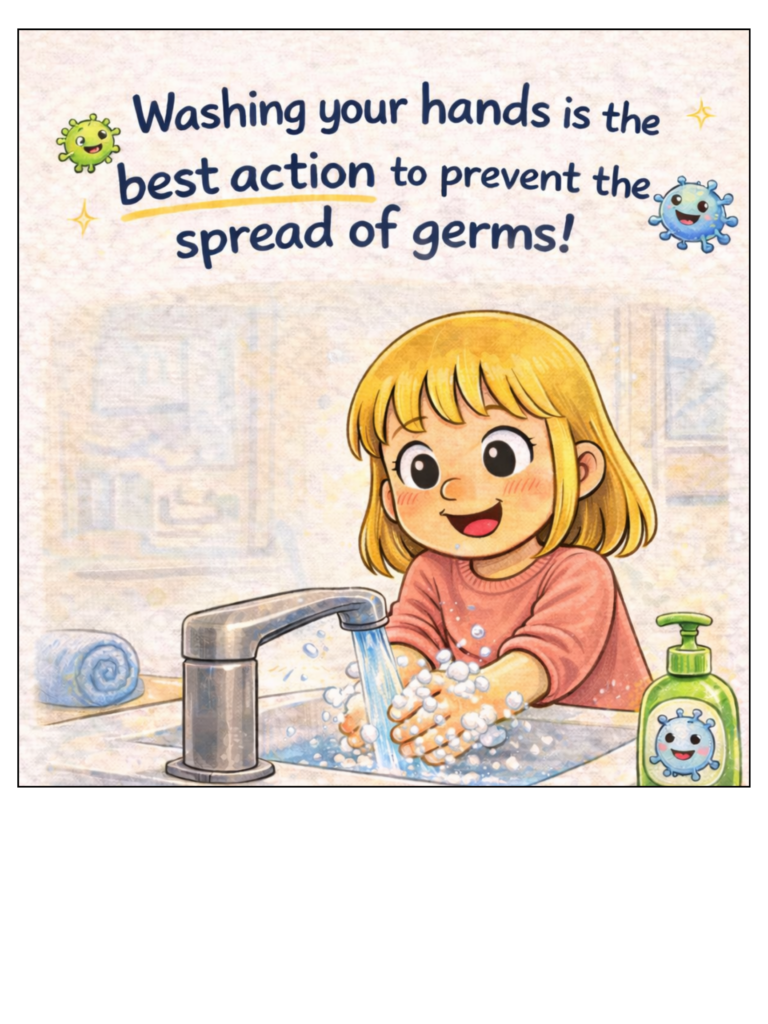
9. Take Action and Wash Your Hands!
This final panel shows how handwashing stops germs before they enter the body. It gives students a clear action they can take and connects prevention.
Theory Applied:
The design of this comic is guided by the Cognitive Theory of Multimedia Learning (Mayer), Cognitive Load Theory, Active Learning principles, and Universal Design for Learning (UDL). Each design decision was intentionally grounded in these frameworks to ensure the resource is developmentally appropriate for Grades 2–4.
1. Cognitive Theory of Multimedia Learning
Segmenting Principle (Information presented in manageable segments)
- The infection process is divided into separate comic panels (exposure → entry → multiplication → immune response → symptoms → prevention)
- This prevents cognitive overload and allows students to process one step at a time, which is appropriate for Grades 2–4 learners.
Coherence Principle (Remove extraneous material that does not support learning)
- Panels include only essential visuals and short captions. Scientific jargon and unnecessary anatomical detail are avoided.
- Reducing extraneous cognitive load allows students to focus on core concepts such as how germs spread and how the body responds.
Signalling Principle (Highlight important information to guide attention)
- Germs and characters are visually emphasized in each panel.
- Directing the learner’s attention
Dual Coding Theory
- An educational comic allows students to process images and text simultaneously through two distinct but interconnected channels.
2. Cognitive Load Theory
The comic intentionally manages all three types of cognitive load:
- Intrinsic Load: Controlled by breaking the infection process into clear, logical steps appropriate for Grades 2–4.
- Extraneous Load: Minimized through simple layouts, concise language, and limited decorative elements.
- Germane Load: Encouraged through cause and effect reasoning and interactive sequencing activities that help students mentally organize information. By visually representing invisible biological processes, the comic strengthens students mental models without overwhelming them.
3. Active Learning
- Prior knowledge activation (Have you ever been sick?)
- Prediction prompts (Do you think Germs or You will win the battle)
- A “Can You Stop the Germs?” interactive game including sequencing the steps of infection and identifying prevention strategies.
4. Universal Design for Learning (UDL)
- Concepts are presented visually (illustrations of germs and characters) and verbally (short captions).
- The narrative structure and interactive game section promote motivation and participation.
- Students demonstrate understanding by circling prevention strategies and ordering the infection sequence.
Prototype
Peer Feedback
The feedback I received emphasized on the strong connection to learning theory throughout the project. They noted that I clearly applied Universal Design for Learning (UDL), cognitive load theory, and segmenting principle. They also noted that the age is appropriate for the Grade 2–4 audience and potentially younger too. The sequencing of the infection process was described as logical, developmentally appropriate, and effective in managing cognitive load. The simplified layouts, concise language, and strong visual supports were recognized as intentional strategies to reduce extraneous load, particularly for students with dyslexia or ADHD. Reviewers also emphasized that the learning objectives are clear and that the opening hook was identified as an effective way to activate prior knowledge and connect the lesson to the student’s experiences.
In addition to these strengths, both reviewers offered suggestions for refinement. They recommended strengthening the interactive “Can You Stop the Germs?” activity by making it more explicitly aligned with active learning principles. Specifically, they suggested incorporating decision-making or branching scenarios that require prediction and problem-solving rather than only sequencing or recall. There was also feedback to enhance engagement by adding more narrative voice and giving the germs clearer personalities to make the concept more memorable. Finally, reviewers questioned how the interactive component could be adapted for students with lower reading levels and suggested including additional supports such as read out loud options or visual cues that the instructor can provide. Overall, the suggested improvements focused on increasing interactivity, strengthening narrative engagement, and ensuring accessibility is embedded not only in the comic itself but also in the assessment component.
Reflect and Refine
Overall, the prototype was effective in translating a complex biological process into an engaging educational comic for Grades 2–4. The strongest aspect of the design was the structured sequencing of the infection process across the panels. Breaking the content into stages supports the Segmenting Principle, which states that learners understand complex processes more effectively when information is presented in chunks and learners are able to engage at their own pace. The simplified layouts, concise text, and tight alignment between visuals and narration also reflected principles of Cognitive Load Theory by minimizing extraneous processing and managing intrinsic load. Additionally, applying Universal Design for Learning during the planning phase particularly by considering students with dyslexia or attention differences strengthened accessibility from the beginning.
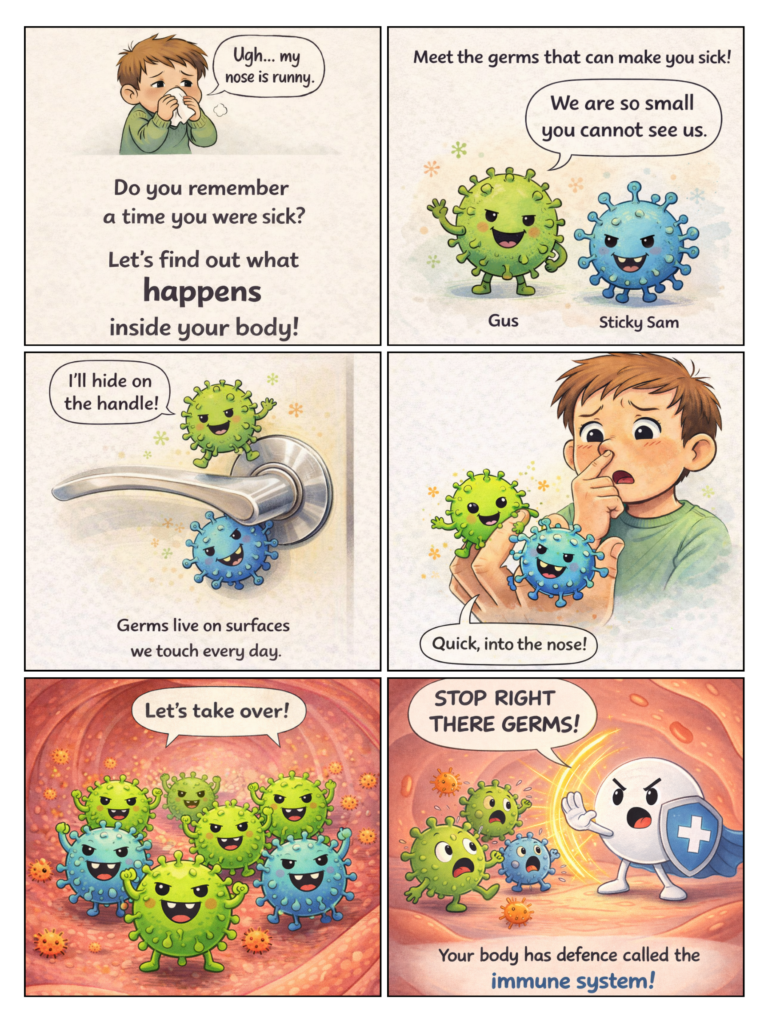
Peer feedback confirmed that the design and curriculum alignment were strong, but it also identified areas for refinement. One issue that was raised was to strengthen narrative engagement by making the comic more “story like” for example by giving the germs more defined traits. In the revised prototype, I incorporated light personification such as names to make germs more memorable without distorting scientific accuracy. This approach draws on dual coding theory, as pairing conceptual explanations with distinctive visual characteristics can enhance retention. I also made the comic into more of a story giving the germs little phrases and more of an adventure aspect to enhance engagement while maintaining cognitive load theory.
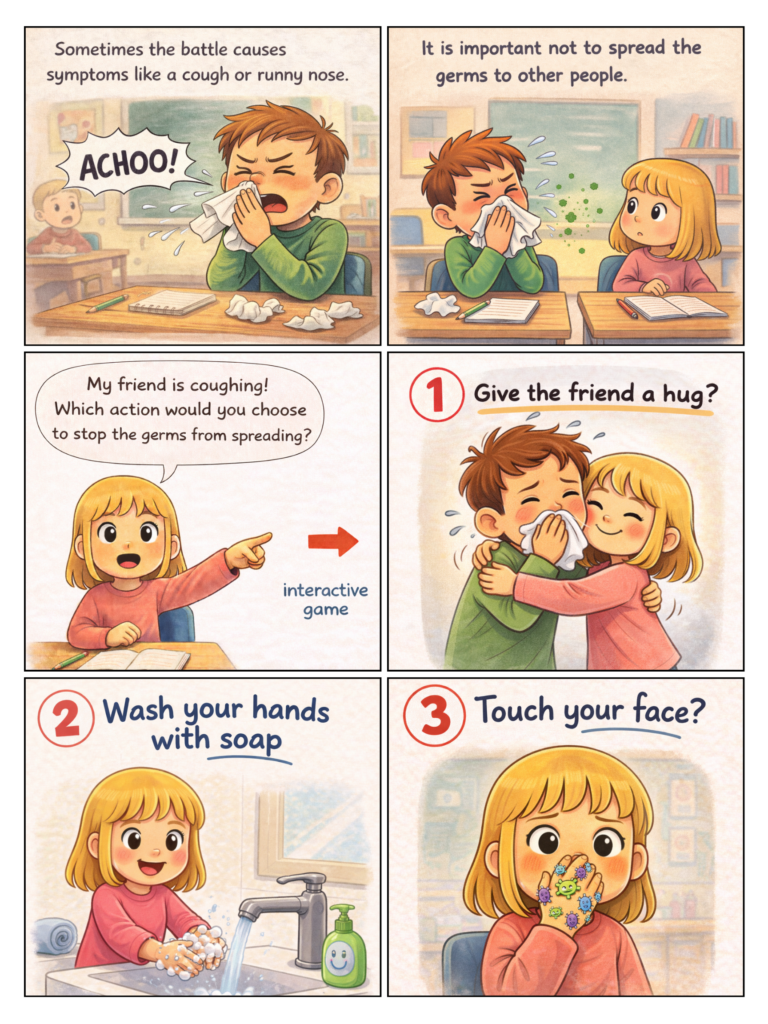
Another issue raised was the need to strengthen the interactive component so that it moves beyond simple recall and encourages predictive decision making. In response, I revised the “Can You Stop the Germs?” activity to include clear visuals and signals, such as arrows and numbered options, making the activity easier to follow and more accessible for young learners. Peer feedback also suggested allowing the instructor to read the activity section aloud so it can be facilitated as a class activity. During revision, I also recognized that the game was not well integrated into the comic’s flow. Converting the activity into visual scenarios helps students attempt the task independently, while the final panel provides an opportunity for the instructor to review the answers with the class and reinforce the key prevention message. This structure allows students to first engage individually with the material and then receive guided clarification if needed, ensuring the activity remains accessible to learners with different needs. Another suggestion was to turn the activity into simple branching scenarios in which students choose between safe and unsafe responses to situations that could spread germs. I included “My friend is coughing which action would you choose to prevent the spread of germs?” This approach aligns more closely with active learning principles, which emphasize engagement through problem solving and decision making. By prompting learners to anticipate the consequences of their choices, the activity encourages deeper cognitive processing rather than passive recognition.
A major strength of comic formatting is the ability to integrate text and visuals simultaneously, supporting dual channel processing and helping learners visualize invisible biological processes. Comics also naturally support segmentation and narrative coherence, which can lower cognitive load and increase engagement. However, without intentional interactive design, comics can remain largely passive learning experiences. The revisions I made to my comic attempt to preserve the strengths of multimedia integration while trying to change a passive experience into a more active learning experience.
Final Artifact
Germs vs You
As you read through this comic, pay attention to the actions and situations that might influence how germs spread and cause sickness. Notice how germs move from surfaces to hands and into the body. At the end of the comic, try the interactive game to see if you can identify the actions that help stop germs. Afterward, the class will review the answers together.
References
CAST. (2024). The UDL Guidelines. https://udlguidelines.cast.org/
Granchelli, A. (2025, November 2). Accessible Multimedia. University of Victoria: Educational Technology. https://edtechuvic.ca/edci337/2025/11/02/accessible-multimedia/
Granchelli, A. (2025, October 19). Models of Active Learning. University of Victoria: Educational Technology. https://edtechuvic.ca/edci337/2025/10/19/models-of-active-learning/
Granchelli, A. (2025, September 14). Storytelling. University of Victoria: Educational Technology. https://edtechuvic.ca/edci337/2025/09/14/storytelling/
Granchelli, A. (2025, September 5). Theories of Multimedia Learning. University of Victoria: Educational Technology. https://edtechuvic.ca/edci337/2025/09/05/theories-of-multimedia-learning/
British Columbia Ministry of Education. (n.d.). Science curriculum. BC’s curriculum: Building student success. https://curriculum.gov.bc.ca/curriculum/science
McLean, E. (2021, January 30). A pile of comics sitting next to each other [Photograph]. Unsplash. https://unsplash.com/photos/a-pile-of-comics-sitting-next-to-each-other-8SeJUmfahu0
Prototype AI Generated Image References
OpenAI. (2026). Elementary school boy sick lying on couch with tissues [AI-generated image created using the prompt: “A cartoon-style digital illustration of elementary school boy lying on a couch sick with tissues nearby. No background.”]. ChatGPT. https://chat.openai.com
OpenAI. (2026). Cartoon bacteria and virus floating [AI-generated image created using the prompt: “Cartoon germs (bacteria and virus), friendly floating with no background. Transparent background.”]. ChatGPT. https://chat.openai.com
OpenAI. (2026). Cartoon germs on hands after touching a door handle [AI-generated image created using the prompt: “Cartoon germs on a child’s hands after touching a door handle. Include the door but no background. Transparent background.”]. ChatGPT. https://chat.openai.com
OpenAI. (2026). Cartoon germ near child’s nose and mouth [AI-generated image created using the prompt: “Cartoon illustration of the same boy (blue jacket, red shirt) with a germ near his nose and mouth. Transparent background.”]. ChatGPT. https://chat.openai.com
OpenAI. (2026). Cartoon germ multiplying from one to three with arrows [AI-generated image created using the prompt: “Cartoon green germ multiplying in a vertical line: one small germ, arrow to two germs, arrow to three germs. Transparent background.”]. ChatGPT. https://chat.openai.com
OpenAI. (2026). Cartoon white blood cells attacking green germs [AI-generated image created using the prompt: “Cartoon white blood cells attacking green cartoon germs. Transparent background.”]. ChatGPT. https://chat.openai.com
OpenAI. (2026). Elementary school boy sitting at desk sick and sneezing into tissue [AI-generated image created using the prompt: “Cartoon illustration of the same boy (blue jacket, red shirt) sitting at school desk sick and sneezing into a tissue. Transparent background.”]. ChatGPT. https://chat.openai.com
OpenAI. (2026). Boy sneezing next to student [AI-generated image created using the prompt: “Cartoon illustration of the same boy (blue jacket, red shirt) sneezing into a tissue next to a girl student. Include lockers but keep background transparent.”]. ChatGPT. https://chat.openai.com
OpenAI. (2026). Girl washing hands with cartoon germs washing away [AI-generated image created using the prompt: “Cartoon illustration of the girl student washing her hands in a school sink with soap bubbles. Include sink and faucet. Add small green cartoon germs washing down the drain. Transparent background.”]. ChatGPT. https://chat.openai.com
Final Artifact AI Generated Image References
OpenAI. (2026). Sick child with runny nose [AI-generated image created using the prompt: “Cartoon illustration of a young boy showing he is sick. Child-friendly educational comic style with simple background.”]. ChatGPT. https://chat.openai.com
OpenAI. (2026). Germ characters Germ Gus and Sticky Sam introduction [AI-generated image created using the prompt: “Cartoon illustration introducing two germs named Germ Gus (green) and Sticky Sam (blue). Friendly educational comic style with names under each germ and narration ‘Meet the germs that can make you sick.’ Simple background.”]. ChatGPT. https://chat.openai.com
OpenAI. (2026). Germs hiding on a door handle [AI-generated image created using the prompt: “Cartoon illustration of two germs sitting on a door handle waiting for someone to touch it. Child-friendly comic style with speech bubble ‘I’ll hide on the handle!’.”]. ChatGPT. https://chat.openai.com
OpenAI. (2026). Child touching face with germs entering through nose [AI-generated image created using the prompt: “Cartoon illustration of a child touching their nose with germs on their fingers. A blue germ saying ‘Quick into the nose!’ Educational comic panel with simple background.”]. ChatGPT. https://chat.openai.com
OpenAI. (2026). Germs multiplying inside the body [AI-generated image created using the prompt: “Cartoon educational panel showing one germ multiplying into many germs within the body. Child-friendly style.”]. ChatGPT. https://chat.openai.com
OpenAI. (2026). Immune system cells fighting germs [AI-generated image created using the prompt: “Cartoon white blood cells fighting green and blue germs. Educational comic style showing the immune system protecting the body.”]. ChatGPT. https://chat.openai.com
OpenAI. (2026). Child sneezing as body fights germs [AI-generated image created using the prompt: “Cartoon illustration of a child sneezing with a tissue at a school desk saying ACHOO. Educational comic panel showing symptoms of sickness.”]. ChatGPT. https://chat.openai.com
OpenAI. (2026). Child coughing near another student showing germ spread [AI-generated image created using the prompt: “Cartoon illustration of a child coughing near another student while germs spread through the air. Child-friendly educational comic panel.”]. ChatGPT. https://chat.openai.com
OpenAI. (2026). Interactive comic panel asking [AI-generated image created using the prompt: “Educational of girl saying “My friend is coughing. Which action would you choose?” including interactive game arrow. Child-friendly style with minimal background.”]. ChatGPT. https://chat.openai.com
OpenAI. (2026). Friends hugging [AI-generated image created using the prompt: “Cartoon illustration of two children hugging showing interactive option 1. Educational comic style demonstrating how germs can spread between people.”]. ChatGPT. https://chat.openai.com
OpenAI. (2026). Child washing hands at sink with soap bubbles [AI-generated image created using the prompt: “Cartoon illustration of a student washing hands with soap in a school sink with bubbles showing interactive option 2.] ChatGPT. https://chat.openai.com
OpenAI. (2026). Child touching face with germs on hands [AI-generated image created using the prompt: “Educational cartoon illustration of a girl touching their face while small cartoon germs sit on their hands showing interactive option 3. Child-friendly comic panel with simple background.”]. ChatGPT. https://chat.openai.com
OpenAI. (2026). Child washing hands at sink with soap bubbles [AI-generated image created using the prompt: “Cartoon illustration of a student washing hands with soap in a school sink with bubbles. with narrative washing your hands is the best action to prevent the spread of germs! ] ChatGPT. https://chat.openai.com